Focused Ultrasound (HiFUs)
The non-invasive HiFUS technique represents a significant advance in the treatment of various neurological disorders. This procedure has been established for more than 10 years and has been used worldwide to treat Parkinson's disease, tremors, and neuropathic pain.
- What is focused ultrasound (HiFUS)?
- How does it work?
- Areas of application
- Who cannot be treated?
- Advantages over conventional procedures
- Treatment procedure – HiFUS
- Before treatment
- During treatment
- After treatment - Risks and possible side effects – HiFUS
- Distinction from deep brain stimulation (DBS)
- When is radiosurgery an alternative?
- Frequently asked questions
- Glossary
WHAT IS FOCUSED ULTRASOUND (HiFUS)?
Focused ultrasound (actually high-intensity focused ultrasound = HiFUS) is a modern, non-invasive treatment method in which sound waves are bundled and precisely directed at a specific area in the brain. You may also come across the terms FUS or MRgFUS (MR-guided focused ultrasound). These abbreviations all mean the same thing. Unlike conventional neurosurgical procedures, the skull is not opened. The innovative HiFUS technology uses the energy of ultrasound waves to treat small areas of the brain without damaging the surrounding healthy tissue.
HOW DOES IT WORK?
Focused ultrasound works according to a simple but effective principle:
- Ultrasound waves are sound waves that are inaudible to the human ear.
- During treatment, hundreds of individual ultrasound beams are precisely directed at a small target point in the brain.
- This bundling causes local heating of up to approximately 60°C at the target point.
- This heat leads to controlled, precise, and permanent deactivation of the nerve cells in the target area, which measures only a few millimeters.
- The surrounding tissue remains completely intact.
The entire treatment is monitored in real time using magnetic resonance imaging (MRI), which ensures maximum precision and safety.
AREAS OF APPLICATION
Focused ultrasound can be used to treat various neurological disorders:
APPROVED INDICATIONS:
- Essential tremor: Uncontrolled shaking of the hands, often during everyday movements
- Parkinson's tremor: Trembling as a symptom of Parkinson's disease
- Parkinson's disease: Various symptoms, often predominantly unilateral (under-/overmobility, stiffness), can be treated
- Movement disorders: Various types of involuntary movements
- Neuropathic pain: Chronic pain caused by nerve damage
FUTURE INDICATIONS (IN DEVELOPMENT):
- Epilepsy: For certain forms that do not respond to medication
- Depression
- Obsessive-compulsive disorder
Your doctor will discuss with you whether HiFUS treatment is suitable for your specific condition.
WHO CANNOT BE TREATED?
PATIENTS WHO...
- cannot undergo an MRI scan
- can only undergo an MRI scan under sedation due to claustrophobia
- suffer from dementia
- already have severe unsteadiness and walking problems, as these could worsen significantly as a result of the treatment.
- have speech problems that could hinder communication during treatment or worsen.
ADVANTAGES OVER CONVENTIONAL PROCEDURES
FOCUSED ULTRASOUND OFFERS SEVERAL ADVANTAGES OVER CONVENTIONAL NEUROSURGICAL PROCEDURES:
- No surgery is necessary: the skull is not opened.
- No radiation exposure, unlike in radiation therapy.
- Short hospital stay: in many cases, only a few days of hospitalization are necessary.
- Lower complication rate: Since no incisions are made and the actual lesion is tested beforehand.
- Faster recovery: Normal activities can often be resumed on the same day or the next.
- Precise effect: Through continuous MRI monitoring.
- Immediate symptom control: The success of the treatment is usually immediately apparent.
TREATMENT PROCEDURE - HiFUS
Treatment with focused ultrasound is divided into three phases:
1. Preparation: Detailed preliminary examinations and planning
2. Implementation: The actual ultrasound treatment
3. Aftercare: Check-ups and follow-up care after treatment
In the following sections, we explain these phases in more detail.
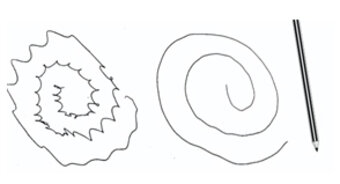
Tipical effect after the procedure:
Before treatment (on the left) and after (on the right)
» Before treatment
The following steps are necessary before the actual treatment:
- Detailed diagnostics: MRI examinations and neurological tests
- Consultation: Detailed explanation of the procedure, treatment alternatives, and answers to your questions
- Informed consent: information about possible risks and side effects
- Preparation on the day of treatment: The hair on the head is shaved to ensure optimal contact for the ultrasound waves.
Please inform your doctor about any pre-existing conditions and medications you are taking.
» During treatment
The treatment procedure is as follows:
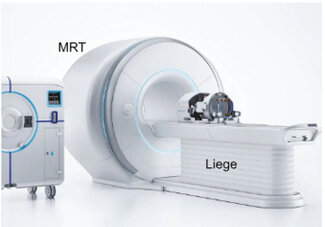
- You lie on the treatment table of a special MRI machine.
- Your head will be secured with a frame to prevent movement.
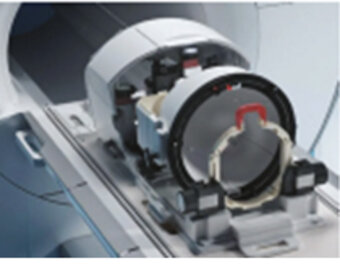
This is painless and is done under local anesthesia.
- A special helmet with ultrasound transducers will be placed on your head.
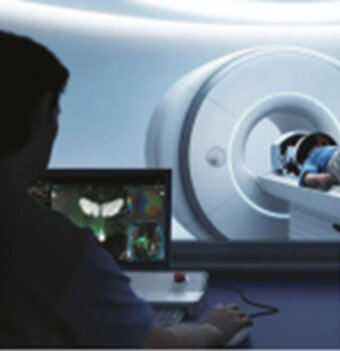
During the procedure, water will be circulated around the upper part of your head to cool the tissue.
- You will remain awake and responsive at all times during the treatment.
- The doctor will perform several low-energy test treatments and
- check the results.
- Once the optimal effect has been confirmed, the actual treatment will begin.
- The entire procedure usually takes 2-3 hours.
» After treatment
After treatment with focused ultrasound:
- Initial clinical check-ups will be carried out.
- You should take it easy physically for 24-48 hours.
- You can resume your normal diet immediately.
- You can usually go home after a few days.
- Further check-ups will be carried out after 1, 3, and 6 months.
Symptoms often improve immediately after treatment and will continue to stabilize over the following weeks.
RISKS AND POSSIBLE SIDE EFFECTS - HIFUS
- As with any medical treatment, focused ultrasound can also have side effects:
- Short-term side effects: headaches, mild nausea, dizziness
- Medium-term side effects: Temporary balance disorders, mild sensory disturbances
- Rare complications: Infections, minor bleeding in the brain, undesirable effects on neighboring areas of the brain with deterioration of gait, speech disorders, sensory disturbances.
However, the risks are significantly lower than those associated with surgical procedures. Your doctor will provide you with comprehensive information about the possible risks.
DIFFERENCE FROM DEEP BRAIN STIMULATION (DBS)
Deep brain stimulation (DBS) is an established treatment method for various neurological disorders. There are important differences between this and focused ultrasound that you should understand in order to make a better decision:
DIFFERENCES BETWEEN THE PROCEDURES:
- Focused ultrasound: Non-invasive procedure without surgery and without the introduction of foreign material into the body.
- Deep brain stimulation: Surgical procedure (5-6 hours of surgery) in which electrodes are implanted in the brain and a neurostimulator (similar to a pacemaker) is implanted under the skin.
DIFFERENCES IN HOW THEY WORK:
- Focused ultrasound: Causes permanent, non-regulatable deactivation of certain areas of the brain (strategic tissue deactivation, Fig. 1)
- Deep brain stimulation: Stimulates certain areas of the brain with electrical impulses; stimulation parameters can also be adjusted after the operation
DIFFERENCES IN AFTERCARE:
- Focused ultrasound: No regular technical checks necessary, no battery replacement
- Deep brain stimulation: Regular checks and adjustments of stimulation parameters, battery replacement of the neurostimulator may be necessary after a few years.
WHICH PROCEDURE IS SUITABLE FOR WHOM?
- Deep brain stimulation: More suitable for younger patients, patients with bilateral symptoms, and those with more complex symptoms that may require readjustment of the therapy
- Focused ultrasound: Particularly suitable for patients with clearly defined symptoms such as unilateral tremor, for older patients, and for patients who do not want surgery.
The decision as to which procedure is best for you depends on various factors, including your specific diagnosis, the stage of your disease, your age, comorbidities, and, of course, your personal preferences. Your treating physician will advise you in detail and recommend the optimal treatment strategy for you.
WHEN IS RADIOSURGERY AN ALTERNATIVE?
In certain situations, radio surgery (also known as Gamma Knife, Cyber Knife, or linear accelerator) can be an alternative to HiFUS. This is particularly relevant in the following cases:
When skull density does not allow for treatment with ultrasound.
Focused ultrasound is not suitable for every patient. An important prerequisite is sufficient skull density, which is referred to as the skull density ratio (SDR). This ratio describes how well the ultrasound waves can penetrate the skull bone.
Skull density is measured before treatment using a special CT scan. At certain skull density values, the ultrasound waves cannot deliver sufficient energy to the target point in the brain, which limits the effectiveness of the treatment.
OTHER SITUATIONS IN WHICH RADIO SURGERY IS CONSIDERED:
- In patients with metal implants in the head area, which make MRI-guided ultrasound treatment impossible
- In patients who want/need a significantly shorter treatment time.
DIFFERENCES BETWEEN RADIO SURGERY AND HiFUS:
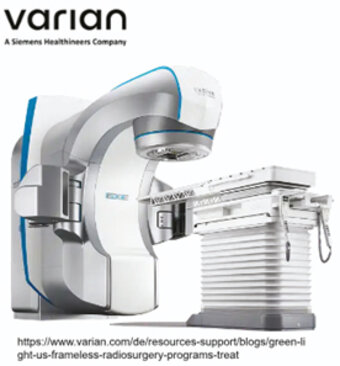
- Principle of action: Radiosurgery (Figs. 8-9) uses high-energy rays instead of ultrasound waves.
- Time course: While focused ultrasound has an immediate effect, the full effect of radiosurgery often only becomes apparent after weeks or months.
- Monitoring: With radiosurgery, real-time monitoring of the effect is not possible.
- Radiation exposure: Unlike HiFUS, radiosurgery exposes the body to radiation.
- With radiosurgery, the head does not need to be shaved and is only fixed in place with a mask system.
- At around 40 minutes, the treatment time is significantly shorter than with HiFUS.
Your doctor will decide which procedure is best for you based on your individual situation, the skull density measurement, and other diagnostic results. In some cases, a combination of different procedures may be appropriate.
FREQUENTLY ASKED QUESTIONS ABOUT HiFUS
» Is the treatment painful?
No, most patients find the treatment painless. Occasionally, a slight feeling of warmth may occur.
» How long will it take before I notice an improvement?
Many patients experience improvement immediately after treatment. The full effect may take several weeks to develop.
» Can I be treated with implants?
Certain metal implants may be a contraindication. This will be clarified during the preliminary examination.
» Is the treatment suitable for all patients?
No, not every patient is suitable for this treatment. The decision is based on your individual diagnosis, your general state of health, and various anatomical factors.
For further information or to arrange a consultation, please do not hesitate to contact us.
GLOSSARY
- Focused ultrasound: Concentration of sound waves for precise treatment within the body
- MRI: Magnetic resonance imaging, an imaging technique that does not involve radiation exposure
- Non-invasive: Treatment without opening the body
- Tremor: Involuntary shaking, often of the hands or head
- Neurosurgery: Surgical treatment of diseases of the nervous system
- Parkinson's syndrome: Neurological disorder with movement disorders
- Epilepsy: Disorder with repeated seizures
- Therapy-resistant: Not responding to conventional treatments
- Deep brain stimulation (DBS): Surgical procedure in which electrodes are placed in the brain to deliver electrical impulses
- Neurostimulator: Implantable device that generates electrical impulses to stimulate nerve tissue
- Radiosurgery: Non-invasive procedure in which highly concentrated radiation is used to treat specific areas of the brain
- Skull density ratio (SDR): Measure of skull density that indicates how well ultrasound waves can penetrate the skull bone